
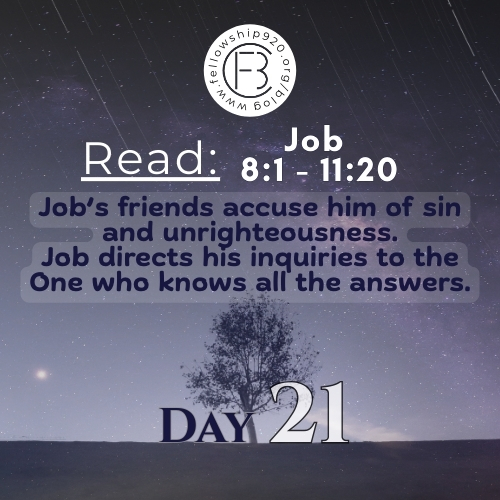
Day 21
Sidenote: You probably noticed that the Book of Job is located several books later in the Holy Bible. Since we are reading the Bible chronologically this is an example of how interesting this journey can be and hopefully enlightening too! The dates of the events in Job are unknown and so is the author. However, there is evidence that supports that the author may have been a well educated man with literary skills. It may have been Job himself after he was restored. Depending on the author assumed, the dates for the writing of Job vary from patriarchal to postexilic times.
Read: Job 8:1 – 11:20
Reflect:
Today’s reading highlights that while God is just, the friends’ simplistic “moral accounting” misses God’s deeper purposes, foreshadowing Christ’s undeserved suffering.
Job knew God to be both all-good and all-powerful, allowing evil and suffering only for a time. God uses even suffering and evil to bring about His greater purposes.
Does God’s justice always work as predictable cause-and-effect, or is there mystery and grace beyond human understanding?
Bildad argues suffering proves sin and his words wound Job.
How do we comfort others without wounding them with assumptions about their sin?
Bildad promises hope for the upright, but Job likely feels abandoned.
In our trials, where do we find hope? In predictable outcomes or in trusting God’s character even when we can’t see His plan?
Day 21 of 365

Leave a Reply